
Bad secondary air pump symptoms are easy to misread, because the pump runs for only a short time after a cold start. This guide lists the signs that really point to the air system, what each one usually means and when it is unwise to keep driving.
On this page
- The symptoms that actually point to the air pump
- 1. Check engine light with a secondary air code
- 2. No pump sound after a cold start
- 3. A loud whine, drone or grinding at cold start
- 4. Squealing or broken belt (belt-driven pumps)
- 5. Burnt smell or melted connector
- 6. Exhaust smell or melted hoses near the system
- 7. A failed smog check
- What about rough idle or poor power?
- Can you drive with a bad secondary air pump?
- How a shop confirms the pump is bad
- Frequently asked questions
The symptoms that actually point to the air pump
A secondary air pump works for a short time after a cold start, so most failures do not change how the car drives once it is warm. RepairPal’s air pump guidance (updated September 2026) puts it plainly: when the pump is malfunctioning, the vehicle may perform normally, but it may fail an emissions inspection and turn on the check engine light. Start with the signs below, roughly in order of how useful they are.
1. Check engine light with a secondary air code
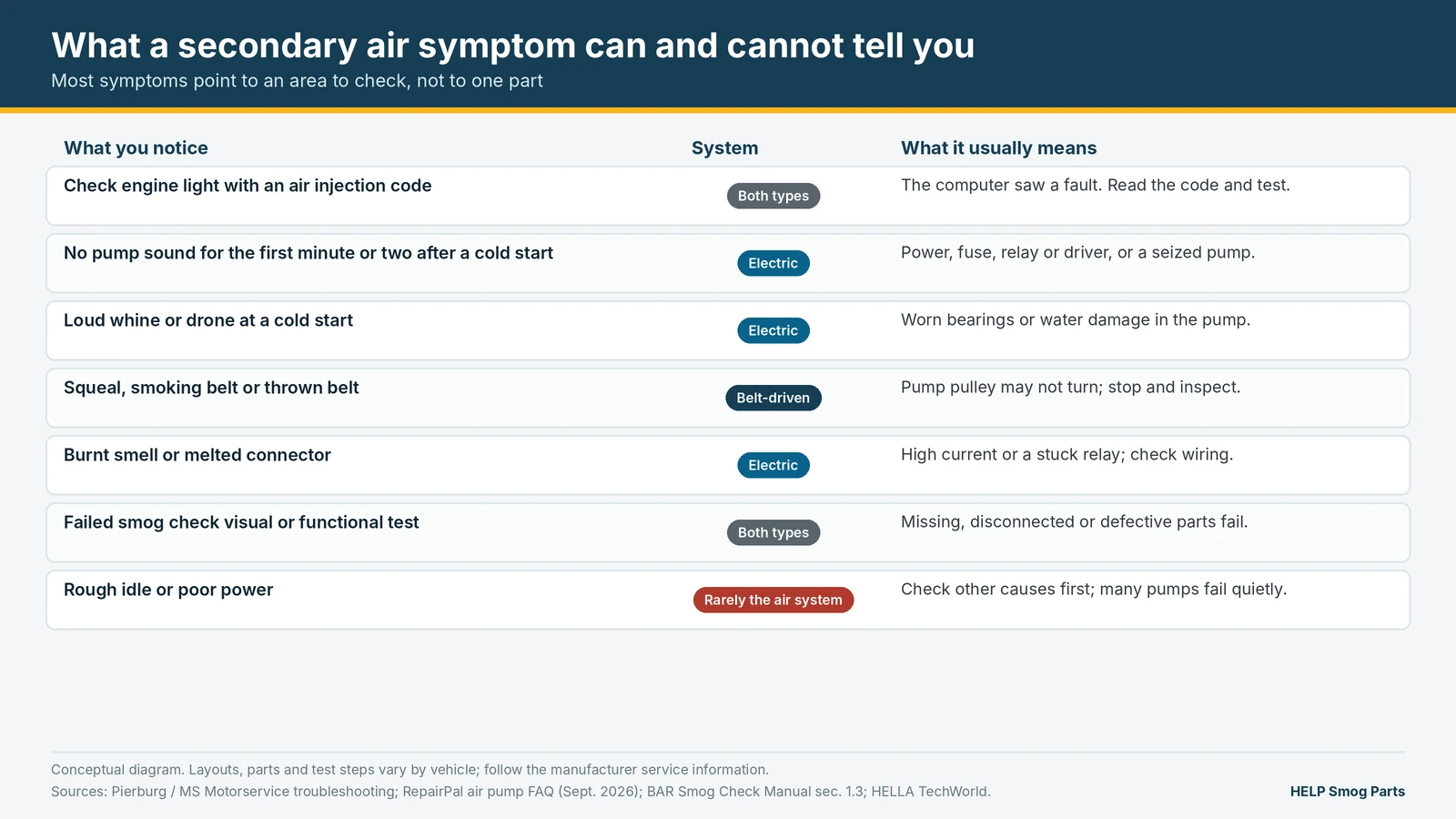
This is the most common sign. Codes such as P0410, P0411, P0418, P0491 and P0492, or Toyota’s P2440 to P2445, tell you the computer saw a problem in the system. They do not tell you which part failed: a fuse, relay, valve, hose or blocked passage can set the same codes. Our P0410 code guide explains the order of checks.
2. No pump sound after a cold start
Many electric pumps are loud enough to hear for the first minute or so after a cold start. FenderBender, a trade magazine for repair shops, says the pump is commonly heard for at least 15 seconds. If you hear nothing on a properly cold engine, the pump may have no power (fuse, relay or driver), a wiring fault, or a seized motor. Our secondary air pump relay guide covers the power side.
3. A loud whine, drone or grinding at cold start
A pump that is much louder than normal often has worn bearings or water damage. Pierburg (MS Motorservice) notes that water and condensate in the pump first cause noise and later cause it to fail. Water usually gets in through a secondary air valve that no longer closes, so the valve should be checked at the same time. See how the secondary air pump check valve works.
4. Squealing or broken belt (belt-driven pumps)
On older belt-driven systems, a pump with failing bearings may squeal, and a seized pump can stop the pulley and destroy the belt. RepairPal advises against driving with a belt-driven pump that will not turn or is excessively noisy, because the belt can overheat, break and knock other belts off.
5. Burnt smell or melted connector
Pierburg lists a charred smell in the engine compartment and melting traces on the pump’s electrical contacts as signs of trouble, and recommends replacing the switching relay as well when that happens. A relay that sticks closed can keep the pump running after it should stop, which overheats it. If you see melted plastic or smell burning, stop and have the circuit checked.
6. Exhaust smell or melted hoses near the system
If the one-way valve fails open, hot exhaust can travel back into the rubber hoses. RepairPal’s check valve guidance says a melted secondary air hose can be caused by a leaking check valve, and that the vehicle should not be driven while hot exhaust is getting into those hoses.
7. A failed smog check
In California, a check engine light that is on with stored codes is a reason to fail, and the BAR Smog Check Manual treats a missing, disconnected, modified or defective air injection system as a failure. Some owners first learn about a pump problem this way.
What about rough idle or poor power?
Several websites list rough running, hesitation or stalling as typical symptoms. On most vehicles a failed electric pump does not cause them. There are exceptions: a cracked vacuum line on a vacuum-controlled valve is a vacuum leak, and a seized belt-driven pump drags on the engine. But rough running has many common causes, so check other systems before blaming the air pump.
Can you drive with a bad secondary air pump?
Usually yes, for a short time, if the car runs normally and none of the warning signs above is present. Do not keep driving if:
- a belt-driven pump will not turn, is very noisy or is damaging the belt;
- you smell burning, see melted connectors or the pump keeps running when it should be off;
- hot exhaust is reaching the hoses (melted or burnt hoses).
Driving without the system, or with it disabled, is a different question. California Vehicle Code 27156 requires required pollution control devices to be correctly installed and in operating condition, so removal or a bypass is not a legal repair for a road vehicle.
How a shop confirms the pump is bad
- Read all codes and freeze-frame data.
- Command the pump on with a scan tool, or listen at a cold start.
- If it does not run, check fuse, relay or driver, power and ground at the connector.
- If it runs, check the valves, hoses and air passages, and look for water in the pump and hoses.
- After repair, clear codes and confirm on a cold start.
If the pump really has failed, our guide to secondary air pump repair helps you choose between new, rebuilt and used replacements. HELP Smog Parts in Visalia catalogs secondary air injection pumps for many vehicles; call 1-800-544-4357 with your vehicle details and part number.
Frequently asked questions
What does a bad smog pump sound like?
A failing electric pump often makes a loud whine, drone or grinding noise for the first minute after a cold start. A dead pump makes no sound at all. A failing belt-driven pump may squeal or make the belt chirp.
Can a bad secondary air pump cause rough idle?
Usually not. On most vehicles the pump only runs briefly after a cold start. A cracked vacuum line on some systems or a seized belt-driven pump can affect idle, but check other causes first.
Can you drive without a secondary air pump?
The engine will run, but in California the system is required equipment on vehicles that came with it. Driving with it removed or disconnected is not legal, and the vehicle will fail its smog check.
How long does a secondary air pump run?
It depends on the vehicle. Supplier and trade sources give examples from about a minute to about 100 seconds after a cold start, and the pump only runs when the engine computer’s conditions are met.
What causes a secondary air pump to fail?
Water is the usual cause on electric pumps, often from exhaust condensate getting past a secondary air valve that no longer seals. Wear, debris and electrical faults such as a stuck relay also cause failures.