The secondary air pump relay switches power to an electric air pump for the short time it runs after a cold start. When the relay fails, the pump either never runs or keeps running. This guide explains what the relay does, the signs of a fault, the codes it can set and how it is checked safely.
On this page
- What the secondary air pump relay does
- Signs of a bad secondary air pump relay
- Codes linked to the relay circuit
- Where is the secondary air pump relay located?
- How to check a secondary air pump relay safely
- Can you bypass the secondary air pump relay?
- Buying a replacement relay
- Frequently asked questions
What the secondary air pump relay does
An electric secondary air pump draws far more current than an engine computer can switch directly. The relay solves that. The computer energizes the relay’s small coil, and the relay’s contacts connect the pump to battery power through a fuse. GM service information for the Corvette describes this arrangement: the powertrain control module supplies a ground to the AIR pump relay, which then powers the pump.
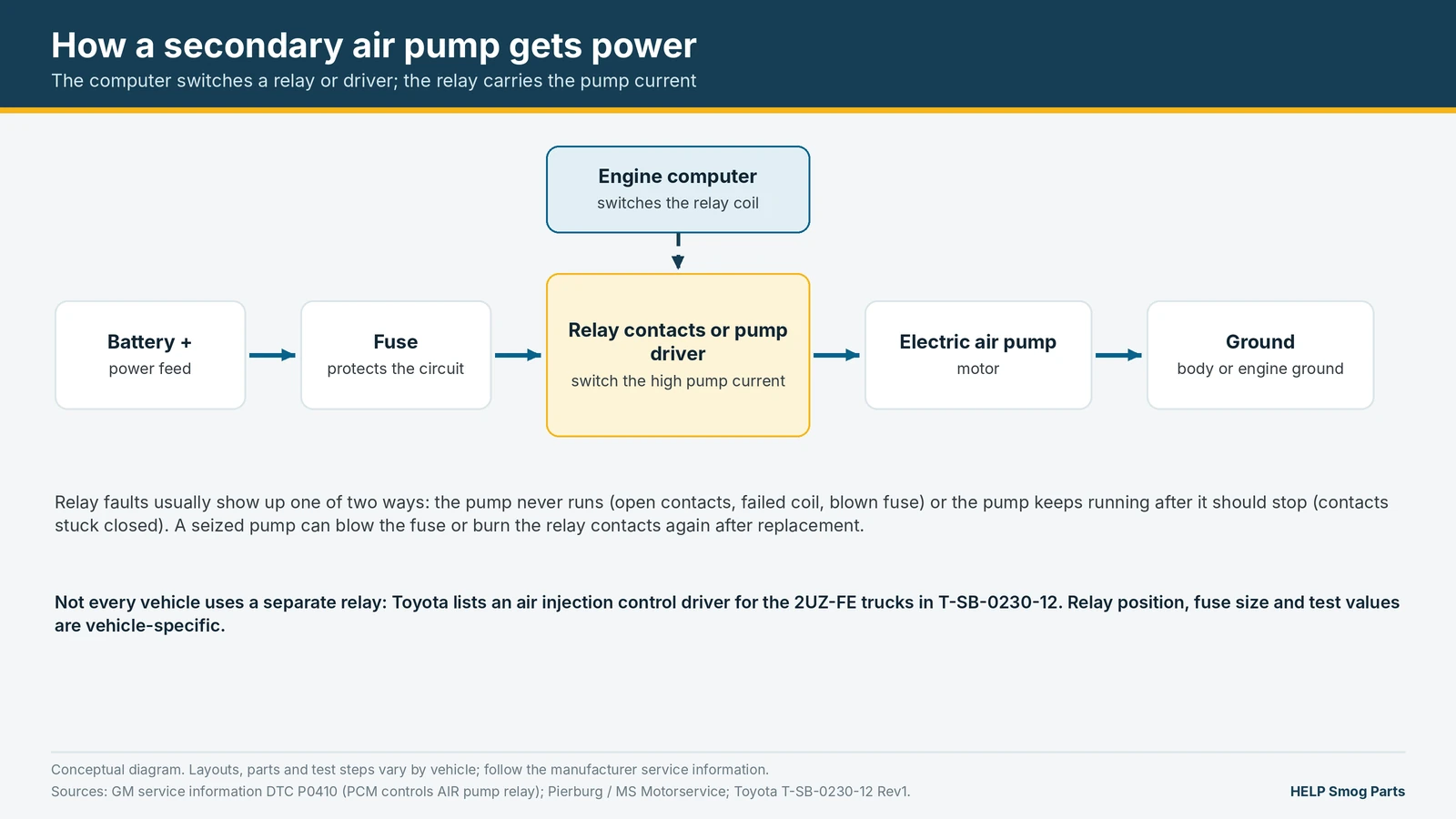
Not every vehicle uses a plain relay. Toyota’s bulletin T-SB-0230-12 for 4.7-liter 2UZ-FE trucks lists an “air injection control driver” and tells technicians to replace it if P0418 or P2445 remain after other repairs. Check the wiring diagram for your vehicle before buying anything.
Signs of a bad secondary air pump relay
Relay faults usually show up in one of two ways.
- The pump never runs. An open coil, burnt contacts or a blown fuse means no power reaches the pump. Expect secondary air codes such as P0410 or P0418 and no pump sound after a cold start.
- The pump keeps running. If the contacts stick closed, the pump can run after it should stop, sometimes with the engine off. That overheats the pump and can drain the battery. Pierburg (MS Motorservice) treats voltage at the pump when it should be off as a sign of a jammed relay.
Pierburg also lists melting traces on the pump’s electrical contacts and a charred smell as reasons to replace the relay along with the pump. A seizing pump draws heavy current and can damage a relay or blow a fuse again even after the relay is replaced, so test the pump as well. Our bad secondary air pump symptoms guide covers the pump side.
Codes linked to the relay circuit
Several codes point at the pump’s control circuit rather than the air path:
- P0418 / P0419: secondary air system control (or “relay”) circuit “A” or “B.” Toyota’s bulletin for 2007-2011 Tundra and 2008-2011 Sequoia uses the name “Control ‘A’ / ‘B’ Circuit.”
- P0410: a general secondary air system failure, often set when the pump never runs. See our P0410 code guide.
- P2444 / P2445: Toyota’s “air pump stuck on” and “stuck off” codes, which can involve the relay or driver as well as the pump.
- P0412: not a pump relay code. It points to the air switching valve “A” circuit; see our P0412 code guide.
Toyota Tundra owners will find more detail in our P0418 Toyota Tundra article.
Where is the secondary air pump relay located?
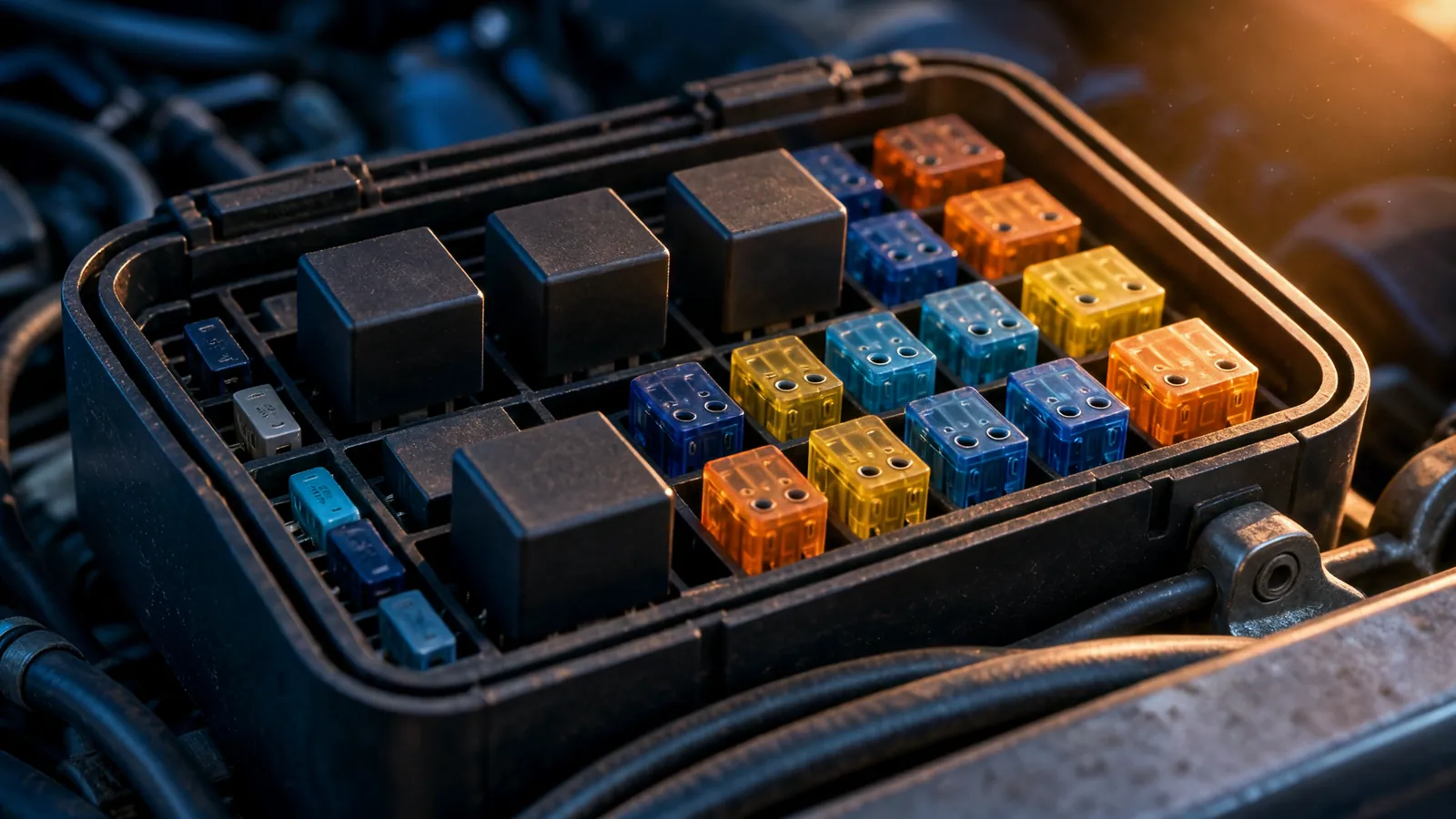
It depends on the vehicle. On many cars and trucks it sits in an under-hood fuse and relay box, and the lid or the owner’s manual names each position. On others it is mounted elsewhere, or the function is built into a separate driver module. Use the fuse box legend, owner’s manual or service information for your exact vehicle. Forum posts and videos that show a relay location are only reliable for the model and year they show.
How to check a secondary air pump relay safely
- Check the fuse that feeds the pump. If it is blown, find out why before replacing it: a seized pump or a short will blow the new one.
- If the owner’s manual shows another relay in the same box with the identical part number, swapping them is a quick check. Do not swap in a relay that only looks similar.
- Use a scan tool that can command the pump on. Listen for the relay click and the pump.
- Following the service information, check for power and ground at the pump connector while it is commanded on. GM’s procedure uses a test lamp at the pump connector for this.
- If the relay clicks but no power reaches the pump, the contacts, wiring or connector are at fault. If power reaches the pump and it does not run, the pump is the problem.
Note: Only work on circuits you are comfortable with. Wrong jumper connections can damage the engine computer, and fuse ratings are vehicle-specific.
Can you bypass the secondary air pump relay?
People search for this, usually to silence a code. Wiring the pump to run all the time will burn it out, and disabling it is not a legal option on a California road vehicle that came with the system: Vehicle Code 27156 requires required emission equipment to be correctly installed and working.
Buying a replacement relay
Relays that look the same can have different pin layouts and ratings. Match the part number from the old relay or the service information. HELP Smog Parts in Visalia focuses on smog pumps and other emission control parts; if your pump has also failed, we catalog secondary air injection pumps for many vehicles. Call 1-800-544-4357 with your vehicle details and part number.
Frequently asked questions
What does the secondary air pump relay do?
It lets the engine computer switch the high current the air pump needs. The computer powers the relay’s coil, and the relay’s contacts connect the pump to battery power through a fuse.
How do I know if my secondary air pump relay is bad?
The pump either never runs after a cold start or keeps running when it should be off. A secondary air code, no relay click when the pump is commanded, or melted contacts are other signs. Test before replacing.
Can a bad relay cause P0418?
Yes. P0418 points to the control circuit for pump “A,” which includes the relay or driver, wiring and the pump. Some vehicles use a driver module instead of a relay.
Will a bad secondary air pump relay drain the battery?
It can, if its contacts stick closed and keep the pump running with the engine off. That also overheats the pump.
Is the secondary air pump relay the same on every car?
No. Ratings, pin layouts and locations vary, and some vehicles use a driver module. Match the part number for your vehicle.