
Anyone restoring a 1960s or 1970s vehicle may meet the air injection reactor system: a belt-driven pump with valves and tubes that feed air into the exhaust. This article covers where A.I.R. came from, how the classic system works, the problems it commonly develops and what to know before restoring it.
On this page
- What the air injection reactor system is
- Where A.I.R. came from
- How the classic A.I.R. system works
- Common problems on classic A.I.R. systems
- Restoring or reinstalling A.I.R. equipment
- Air injection reactor pump vs air injection reaction pump
- Finding A.I.R. parts for a classic
- Frequently asked questions
What the air injection reactor system is
The Air Injection Reactor, usually written A.I.R., is General Motors’ name for an early exhaust emission control. A belt-driven pump blows fresh air into each exhaust port, where the hot exhaust and the extra oxygen let leftover hydrocarbons and carbon monoxide keep burning. Ford’s version was called Thermactor. Today the same idea is called secondary air injection, and the pump is usually called a smog pump. Our guide to what a smog pump does compares the classic and modern designs.
Where A.I.R. came from
California led. The state’s Motor Vehicle Pollution Control Board records from 1965 show General Motors receiving a certificate of approval for factory installation of its “Air Injection Reactor” system (Resolution 65-17) and Ford for its “Thermactor” system (Resolution 65-18), both for 1966 models. A 1966 paper by GM engineers, published by SAE as paper 660106, describes A.I.R. as installed on most 1966 GM cars and light trucks sold in California.

Federal standards followed for the 1968 model year, according to a HOT ROD/MotorTrend history, and air injection spread far beyond California. Not every engine got a pump: some manufacturers met the early rules with carburetor and ignition changes, and some later designs used pulse-air valves that draw air in with exhaust pulses instead of a pump. By the mid-1970s, California certification documents list A.I.R. together with EGR and an oxidation catalyst on GM models such as the 1975 Buick LeSabre.
How the classic A.I.R. system works
The 1975 Buick service manual’s section on emission controls describes the parts and how they work together.
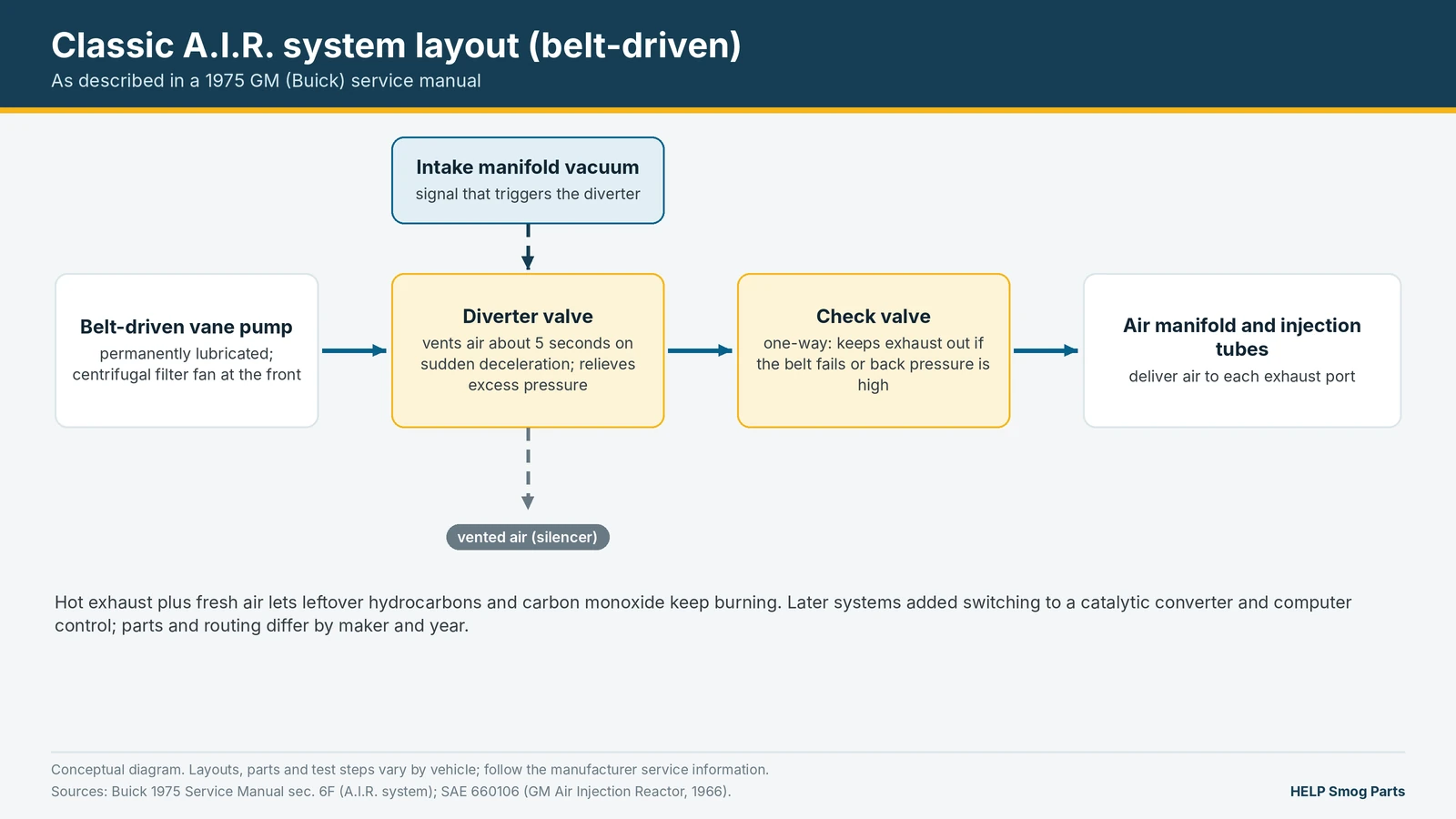
- Air pump: a belt-driven vane pump, permanently lubricated, with a centrifugal filter fan behind the pulley that throws dirt out of the incoming air. The manual says not to lubricate it.
- Diverter valve: senses a sudden rise in intake manifold vacuum when the throttle snaps shut, and sends the pump’s air away from the exhaust for a few seconds so the rich mixture does not backfire. It also relieves excess pressure, venting through a silencer.
- Check valves: one-way diaphragm valves that let air into the exhaust but keep hot exhaust out of the hoses and pump if the belt fails, back pressure rises or a hose ruptures.
- Air manifolds and injection tubes: carry the air to each exhaust port.
Because the pump turns whenever the engine runs, the system works all the time the valves allow it. That is different from modern electric systems, which run for a short time after a cold start.
Common problems on classic A.I.R. systems
- Seized or noisy pump: worn bearings, a damaged filter fan or internal corrosion. A pump that will not turn can destroy the drive belt.
- Failed check valve: exhaust heat reaches the hoses and pump, leaving burnt hoses and a damaged pump. See secondary air pump check valve for how these valves fail.
- Diverter valve faults: a split diaphragm or vacuum line can cause backfire on deceleration or constant venting.
- Missing parts: many classics have had pumps, brackets, tubes or valves removed over the years.
For symptoms in general, see bad secondary air pump symptoms.
Restoring or reinstalling A.I.R. equipment
For collectors, the original A.I.R. equipment is part of the car’s history. MotorTrend’s HOT ROD history notes details restorers check, such as pump date codes and the color of the filter fan, which changed during the early 1970s on Corvette pumps. Match pumps, brackets and pulleys to your engine by part number and casting numbers rather than by appearance.
If your car came with A.I.R., California law treats it as required equipment. Vehicle Code 27156 requires required pollution control devices to be correctly installed and in operating condition. Whether your particular classic also needs a smog check depends on its model year and the current rules, so check with the Bureau of Automotive Repair or the DMV before you register or sell it. “Delete” brackets and de-veined pumps sold for show or racing are not a legal fix for a road vehicle here.
Air injection reactor pump vs air injection reaction pump
Both phrases describe the same belt-driven pump. “Reactor” is GM’s original name; “reaction” appears in many aftermarket catalogs. When you buy one, the name matters less than the part number and the application.
Finding A.I.R. parts for a classic
Original pumps for 1960s to 1990s vehicles are getting harder to find. HELP Smog Parts in Visalia specializes in obsolete smog parts and catalogs smog pumps for many older and classic applications. Call 1-800-544-4357 with the year, make, model, engine and the number on your old pump, and we will check whether we list it.
Frequently asked questions
What is an air injection reactor?
It is General Motors’ name for an early exhaust emission control in which a belt-driven pump blows fresh air into the exhaust ports so leftover fuel and carbon monoxide keep burning.
When was the air injection reactor system introduced?
California records show GM’s Air Injection Reactor certified for factory installation on 1966 models, and SAE paper 660106 describes it on most 1966 GM cars and light trucks sold in California.
What does the diverter valve do on an A.I.R. system?
It senses high intake vacuum when the throttle closes suddenly and briefly diverts the pump’s air away from the exhaust to prevent backfire. It also relieves excess pump pressure.
Is A.I.R. the same as EGR?
No. A.I.R. adds fresh air to the exhaust. EGR sends a metered amount of exhaust back into the intake. Many 1970s vehicles used both, as California certification documents show.
Can I remove the A.I.R. pump from my classic car?
On a California road vehicle that was built with A.I.R., Vehicle Code 27156 requires the equipment to be installed and working. Check current smog check rules for your model year with BAR or the DMV.