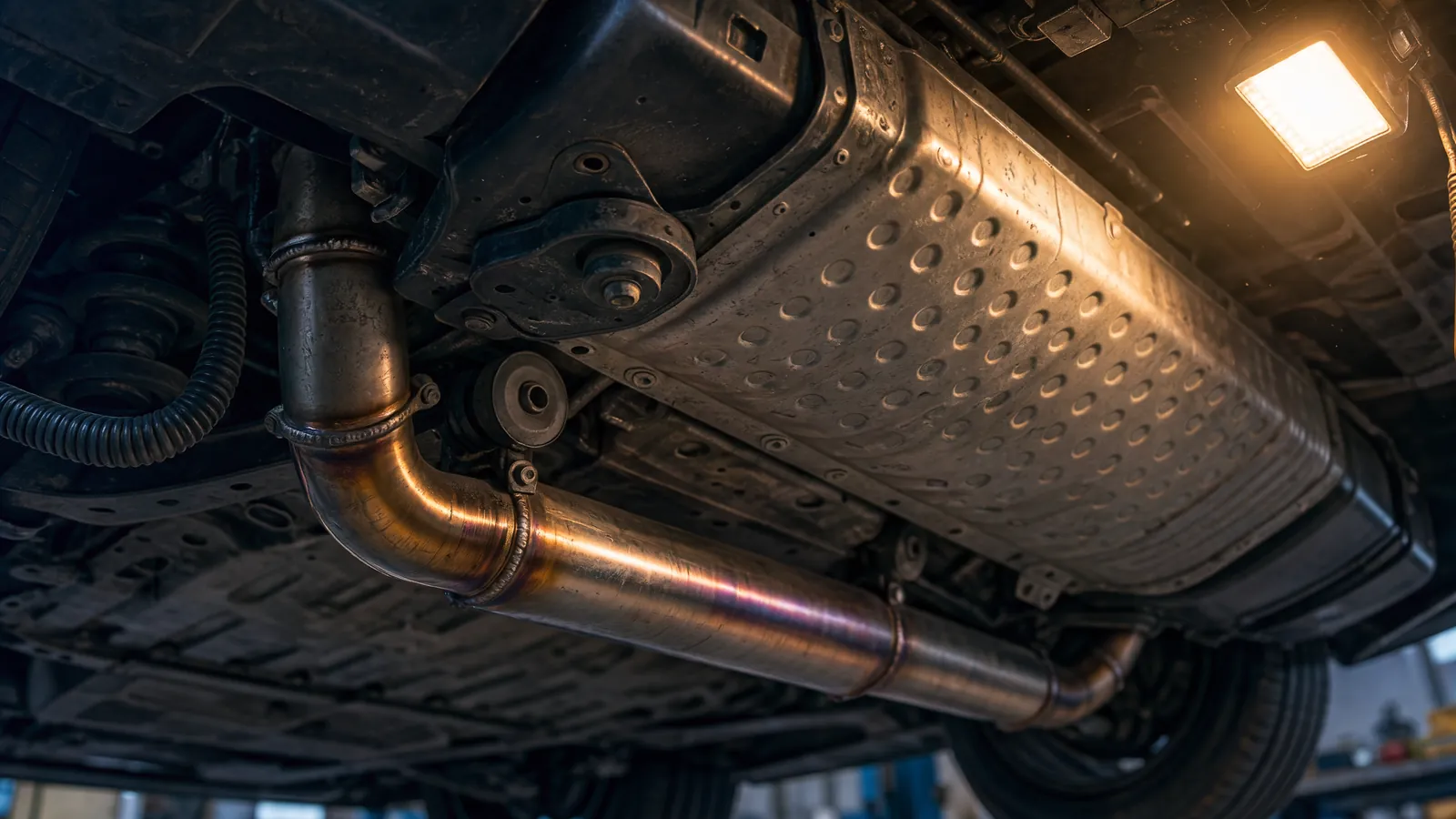
A secondary air pump check valve is a small part with an important job: it keeps hot exhaust and moisture away from the air pump and its hoses. This guide, which also covers what many parts catalogs call the air injection check valve, explains what the valve does, how it fails and how it is checked.
On this page
- What a secondary air pump check valve does
- Air injection check valve, combination valve or switching valve?
- Signs of a bad check valve
- How the valve is checked
- Can you drive with a bad secondary air check valve?
- Should you replace the check valve with the pump?
- What a check valve replacement costs
- Not the aquarium kind
- Help from HELP Smog Parts
- Frequently asked questions
What a secondary air pump check valve does
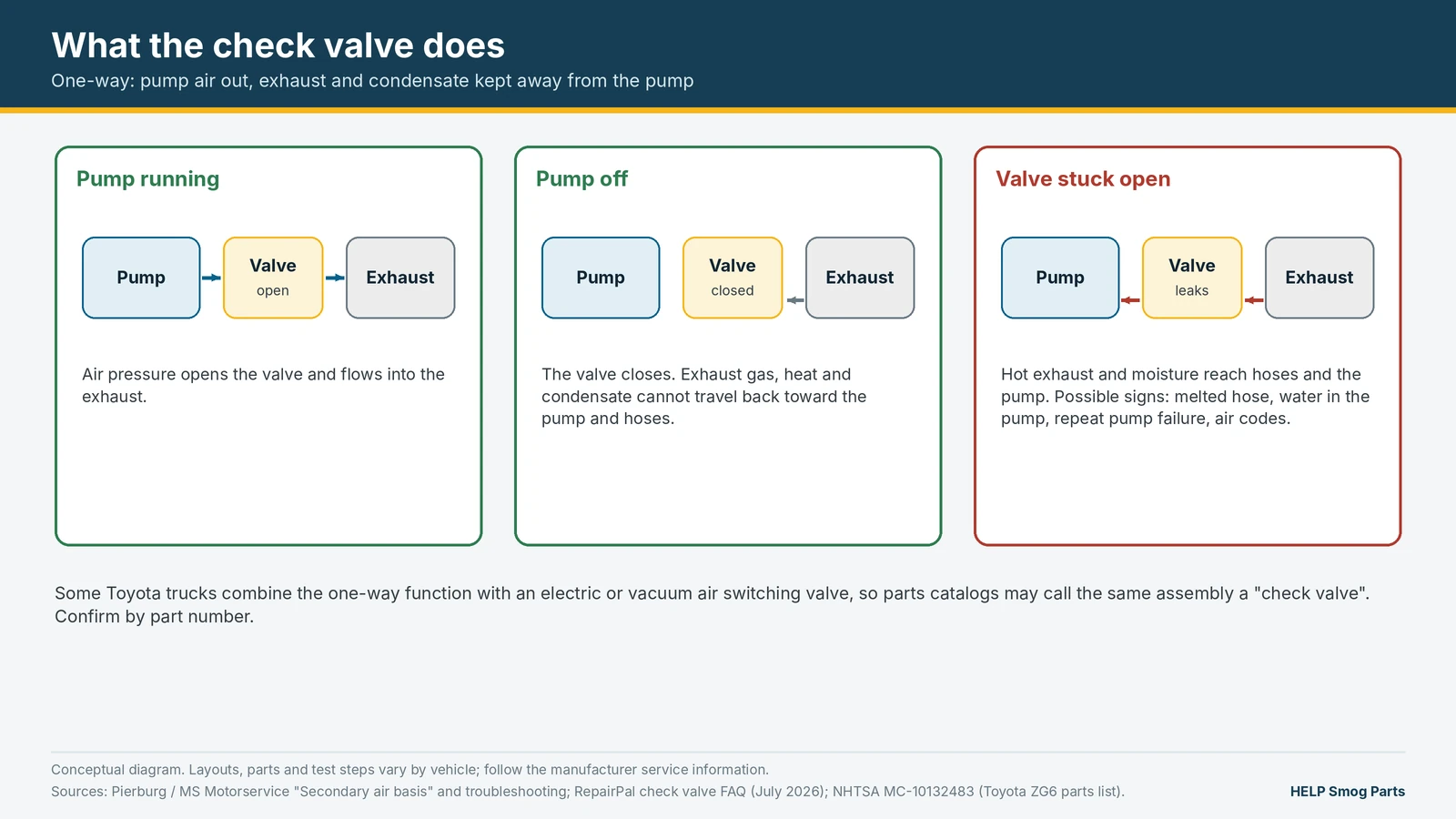
The check valve sits between the secondary air pump and the exhaust. It has one job that matters a lot: let air from the pump flow into the exhaust, and stop exhaust gas from flowing back the other way. Pierburg (MS Motorservice) describes the secondary air valve as doing two things at once: as a non-return valve it keeps exhaust condensate and pressure peaks out of the pump, and as a shut-off valve it lets air into the manifold only when it is needed.
On older belt-driven systems the job was done by a simple one-way diaphragm valve. A 1975 Buick service manual explains that it protects the pump and hoses from hot exhaust if the belt fails, back pressure rises or a hose ruptures. Our article on the air injection reactor system shows where it sits on classic engines.
Air injection check valve, combination valve or switching valve?
The names overlap, which makes parts shopping confusing.
- Mechanical check valve: a one-way valve that opens under pump pressure. RepairPal describes check valves as either purely mechanical or vacuum operated.
- Combination valve: common on European cars; opened by vacuum through a solenoid, and one-way when closed. HELLA’s troubleshooting guide covers this type.
- Air switching valve: on many Toyota trucks, an electrically operated valve that also blocks backflow. A Toyota dealer parts catalog lists part 25702-31014 as a “secondary air injection pump check valve,” while Toyota’s own warranty program document for 2011 Tundras lists the same number as “valve set, emission control, No. 2.”
The lesson: shop by part number for your engine, not by the name on the box.
Signs of a bad check valve
- Secondary air codes: a valve stuck closed blocks the air and can set flow codes such as P0410, P0411, P0491 or P0492. Toyota uses P2440 to P2443 for switching valves stuck open or closed.
- Burnt or melted hoses: RepairPal’s check valve guidance says a melted secondary air hose can be caused by a leaking check valve.
- Exhaust smell or noise from the air hose when the pump is off.
- Water in the pump or hoses, or a pump that fails again: trade sources such as FenderBender say water that kills pumps usually comes from exhaust condensate getting past a valve that no longer seals.
- Failed smog check: with the check engine light on, or if the system has been tampered with.
The car may drive normally. RepairPal notes a vehicle with a bad check valve may perform normally but fail an emissions inspection. More detail on pump-side symptoms is in our guide to bad secondary air pump symptoms.
How the valve is checked
The exact test depends on the valve type and comes from the service information for your vehicle. General checks described by HELLA, Pierburg and FenderBender include:
- With the pump off, the valve should be closed. HELLA blows gently into the line from the pump side to confirm it does not pass air, and warns against using compressed air.
- On vacuum-operated valves, the valve should open when vacuum is applied. Pierburg notes that pneumatic secondary air valves need a minimum vacuum to open, which it gives as 390 mbar for the valves it covers.
- With the engine running and the pump off, noise, exhaust smell or heat at the pump-side hose suggests the valve is not closing.
- Look for carbon deposits, corrosion and water. Pierburg recommends checking the valve for deposits whenever a pump has failed.
Note: Exhaust parts get very hot. Let the engine cool before touching valves, hoses or pipes.
Can you drive with a bad secondary air check valve?
It depends which way it has failed. RepairPal advises that a vehicle should not be driven if the check valve is letting hot exhaust into the rubber hoses, because that can damage hoses and other parts. A valve that is only restricted, blocking air in both directions, is usually less urgent but still needs repair to pass a smog check. In California, Vehicle Code 27156 requires required emission equipment to be correctly installed and in operating condition, so removing the valve or blocking off the system is not a legal fix.
Should you replace the check valve with the pump?
Have it inspected whenever the pump is replaced. If water or deposits are found, replacing the valve is often the difference between a lasting repair and a second failed pump. Toyota’s bulletin for 2007-2011 Tundra and 2008-2011 Sequoia, for example, calls for replacing the pumps and emission control valves together on several engines when water is found. Our secondary air pump repair guide covers the full decision.
What a check valve replacement costs
RepairPal estimates last updated September 3, 2026 show how much this varies: $264 to $293 for a 1994 Chevrolet Caprice and $538 to $626 for a 2014 Chevrolet Equinox, before taxes and fees. Valves that are part of an electric switching valve assembly, or that sit under the intake, cost more. See our secondary air injection pump replacement cost guide for how each line of the bill works.
Not the aquarium kind
Searches for “air pump check valve” also bring up the small plastic valves used on aquarium and air compressor lines. Those are not interchangeable with automotive secondary air valves, which handle exhaust heat and pressure.
Help from HELP Smog Parts
HELP Smog Parts in Visalia catalogs smog pumps and other emission control parts for many older and hard-to-find vehicles. Call 1-800-544-4357 with your year, make, model, engine and the part number on your valve, and we will tell you whether we can help.
Frequently asked questions
What does a secondary air pump check valve do?
It lets air from the pump into the exhaust and stops exhaust gas, heat and condensate from flowing back into the hoses and pump.
What happens when an air injection check valve fails?
If it sticks closed, the air cannot reach the exhaust and secondary air codes can set. If it leaks or sticks open, hot exhaust and moisture reach the hoses and pump, which can melt hoses and ruin the pump.
Is the check valve the same as the air switching valve?
On some vehicles they are separate parts; on others, such as many Toyota trucks, one electrically operated valve does both jobs and parts catalogs may call it a check valve. Confirm by part number.
Can a bad check valve cause a pump to fail?
Yes. Supplier and trade sources say exhaust condensate getting past a valve that does not seal is a common reason electric pumps corrode and fail.
How long does a secondary air check valve last?
There is no set interval. RepairPal notes that life varies widely by vehicle and that road salt and rust can shorten it. Check it whenever the pump fails or air codes appear.