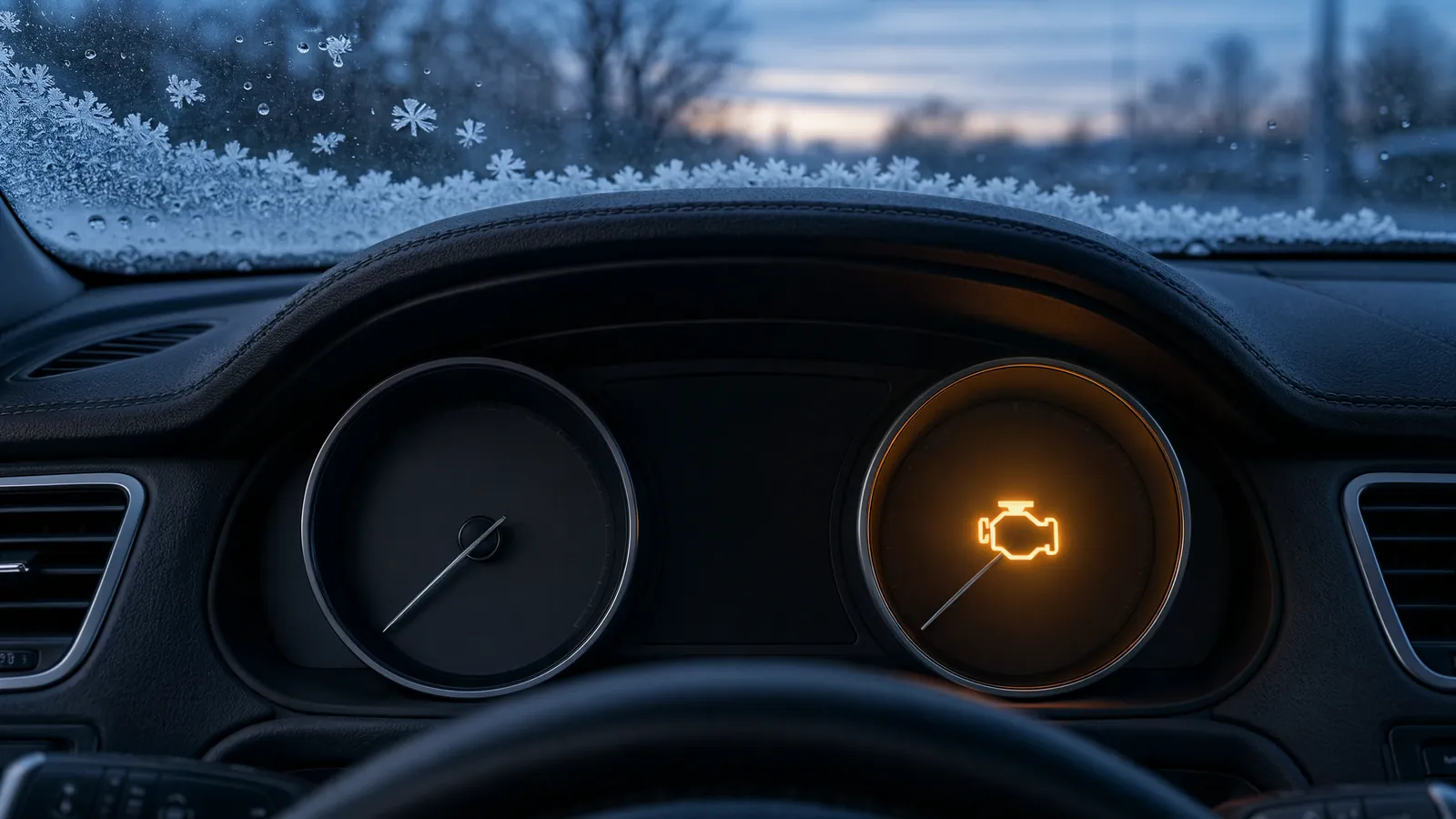
A check engine light with code P0410 means the engine computer ran its secondary air test after a cold start and did not see the result it expected. This guide explains what P0410 checks, the faults that usually cause it and the order in which to check them before any part is replaced.
On this page
What P0410 means
P0410 is the generic OBD II code for “Secondary Air Injection System Malfunction.” It does not name a broken part. It means the engine computer switched the secondary air system on during a cold start, looked for the result it expected, and did not see it.
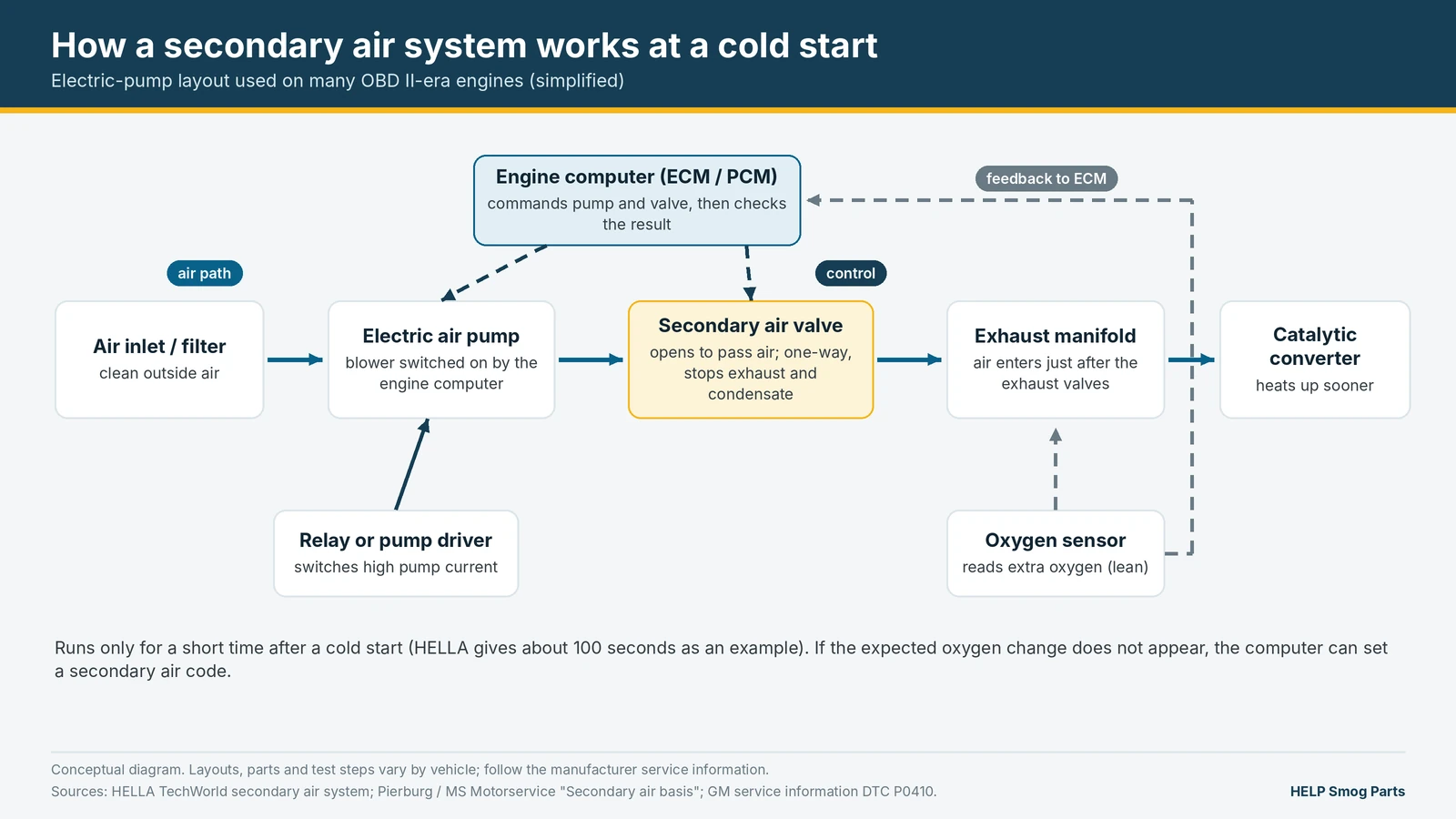
On engines that have this system, an air pump pushes outside air into the exhaust for a short time after a cold start. The extra oxygen lets leftover fuel keep burning in the hot exhaust, which cuts hydrocarbon and carbon monoxide output and heats the catalytic converter sooner. HELLA describes the system switching off after about 100 seconds on many cars; the exact time is set by each manufacturer. Our guide to what a smog pump does explains the parts in more detail.
How the computer decides to set P0410
The test is simple in principle. When the pump runs, the exhaust should turn noticeably lean, and the upstream oxygen sensor and fuel trim should show it. GM service information for P0410 on the Corvette describes the computer commanding the air pump on during a test in closed loop and setting the code if the oxygen sensor voltage does not fall below a set value for a set time, or if short-term fuel trim does not change as expected. Some later systems watch a pressure or airflow sensor instead.
GM lists the code as a “second trip” fault on that application: the check engine light comes on after the test fails on two consecutive trips. Other makers use their own limits and timing, so treat any single number you read online as an example, not a rule for your vehicle.
Note: Because the test runs only after a cold start, a quick check with a warm engine can miss the problem. Save the freeze-frame data before you clear anything.
Common causes of P0410
The code tells you the air did not arrive, or the computer could not confirm it. The cause can be anywhere in the chain from power supply to exhaust port. GM’s diagnostic aids list low airflow, exhaust back pressure, moisture or debris in the pump, kinked hoses and inlet restrictions. Other common findings:
- Pump not running: blown fuse, failed relay or pump driver, broken wire, poor ground, or a seized pump motor.
- Pump running but no air arriving: a secondary air valve (often called a check valve or combination valve) stuck closed, a vacuum or solenoid control fault, a split or disconnected hose, or carbon-blocked air passages.
- Water in the system: trade sources such as FenderBender and Pierburg (MS Motorservice) point out that the water that corrodes failed pumps usually comes from exhaust condensate getting past a secondary air valve that no longer seals. Replacing the pump without fixing the valve can lead to a repeat failure.
- Sensor side: a slow oxygen sensor or another fault that keeps the computer from seeing the change. Check any other stored codes first.
What to check first
A methodical order saves money. The chart below follows the logic in GM’s service information and HELLA’s troubleshooting guide; your vehicle’s procedure takes priority.
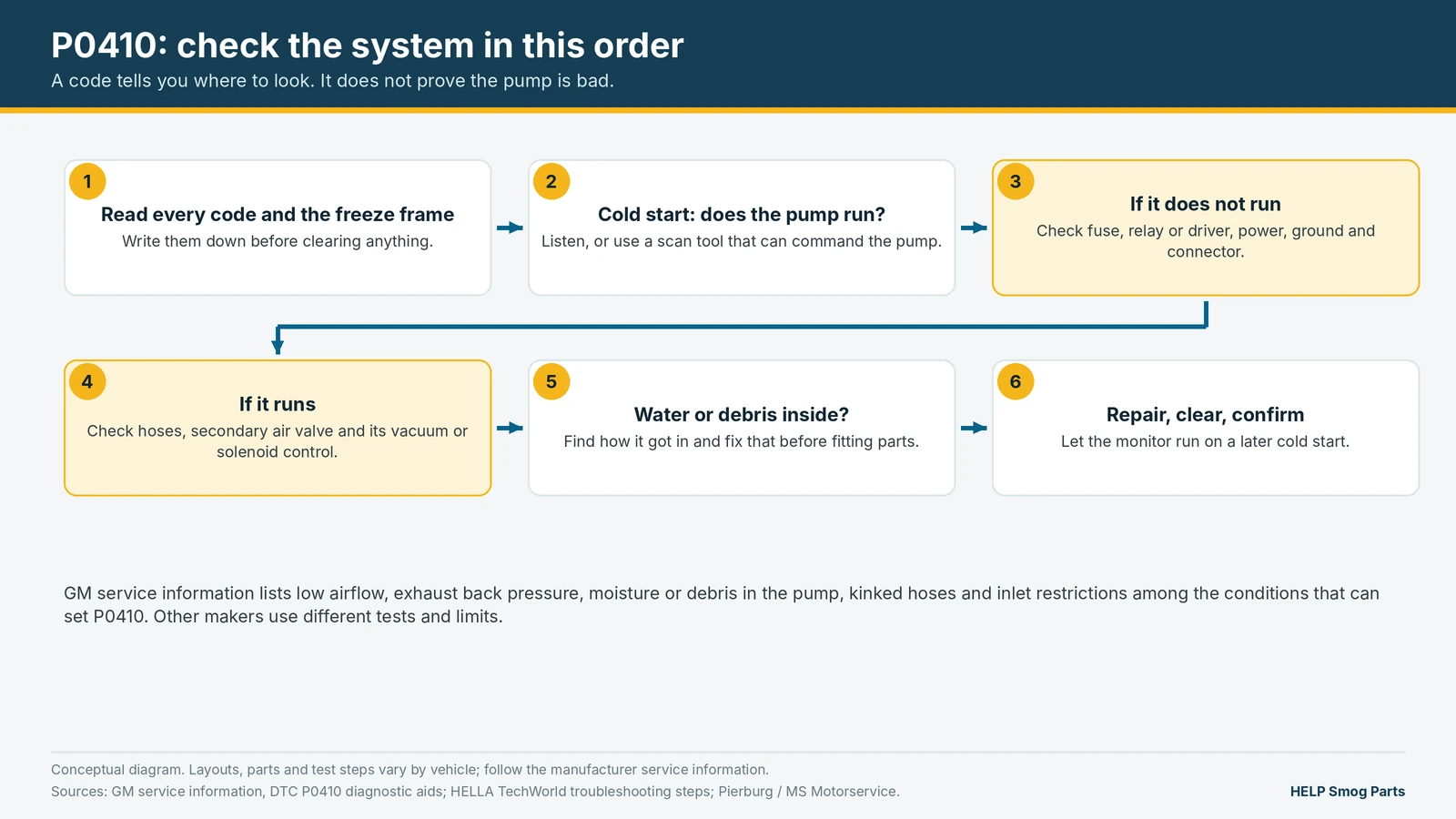
- Read every stored code and the freeze-frame data. Note related codes such as P0411, P0418 or P2440-P2445; a P0412 code points to the switching valve circuit rather than the pump.
- On a cold start, confirm whether the pump runs. Many electric pumps are loud enough to hear for the first minute or so; a scan tool with an actuator test can command it on.
- If it does not run, check the fuse, relay or pump driver, power and ground at the pump connector. Our secondary air pump relay guide covers that circuit.
- If it runs, check the air path: hoses, the secondary air valve and its vacuum or electrical control, and the injection passages.
- If you find water or debris in the pump or valves, find how it got in. See how the check valve protects the pump.
- After the repair, clear the code and let the monitor run on a later cold start.
Is the pump the problem?
Sometimes, but the code alone does not prove it. RepairPal’s air pump guidance (updated September 2026) notes that a secondary air code can also come from a restricted passage or pipe, a defective check valve, a bad relay or a wiring problem. FenderBender’s shop article goes further and says a failed pump is rarely the original problem. Test before you buy. If the pump really has failed, our article on bad secondary air pump symptoms explains the warning signs and what they can and cannot tell you.
Can you drive with P0410?
In most cases the car will drive normally, because the system only works for a short time after a cold start. RepairPal notes that a vehicle with an air pump problem may perform normally but fail an emissions inspection. There are exceptions. On an older belt-driven pump, a seized pump can break the drive belt. On an electric system, a stuck relay can keep the pump running and burn it out. If you notice a burning smell, a melted connector or a squealing belt, stop and have it checked.
In California, the bigger issue is the smog check and the law. The BAR Smog Check Manual treats a secondary air system that is missing, modified, disconnected or defective as a failure, and California Vehicle Code 27156 requires required emission equipment to be correctly installed and in operating condition. Disabling the system or using a code-delete tune is not a legal fix for a road vehicle.
P0410 on Chevy and Mercedes models
Searches for “P0410 Chevy” and “P0410 Mercedes” are common because both brands used electric secondary air pumps on many engines. The meaning of the code is the same; the parts, valve design, relay location and test procedure are not. Use the service information for your exact year, engine and VIN rather than a generic parts list.
Where HELP Smog Parts fits in
HELP Smog Parts in Visalia catalogs secondary air injection pumps and other emission control parts, including many hard-to-find applications. We do not perform smog inspections or diagnose vehicles. Once your shop has confirmed which part failed, call 1-800-544-4357 with the year, make, model, engine and any part number so we can check whether a listed part fits.
Frequently asked questions
What does code P0410 mean?
It means “Secondary Air Injection System Malfunction.” The engine computer ran its cold-start test of the secondary air system and did not see the expected result, usually a lean change at the oxygen sensor.
Will P0410 fail a California smog check?
A check engine light that is on with stored codes is a reason for a smog check failure, and the BAR Smog Check Manual treats a missing, disconnected, modified or defective secondary air system as a failure. The station makes the final decision for your vehicle.
Can a bad relay or fuse cause P0410?
Yes. If the pump never gets power it cannot move air, so the test fails. Check the fuse, relay or pump driver and the wiring before replacing the pump.
Why does P0410 come back right after I clear it?
The fault is still there and the test runs again on the next qualifying cold start. Clearing codes also resets readiness monitors, so clear them only after the repair.
Is P0410 the same as P0411?
No. Both are secondary air codes, but P0411 is “incorrect flow detected.” Many makers use P0410 for a general system failure and P0411 for flow that is present but outside limits. Check the definition your manufacturer uses.